What the heck is EBITDA?
A story about coffee, confused stickmen,
and the number investors actually care about.
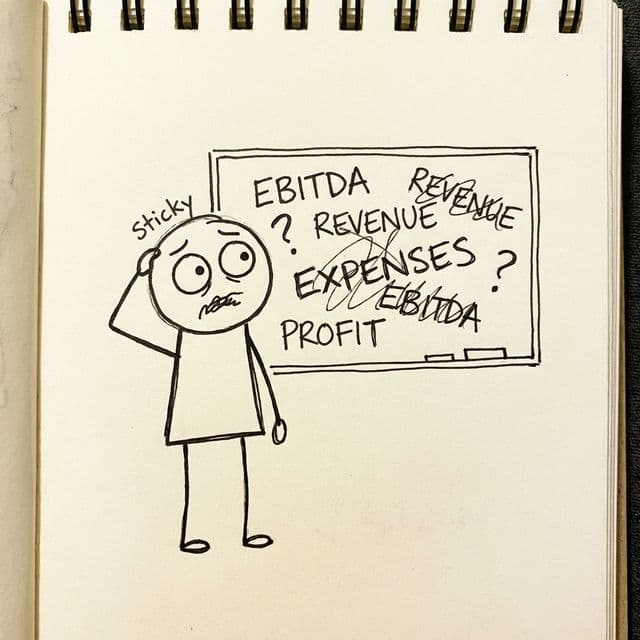
“Wait, how does this work again?”
Okay so picture this. There's this stickman. Let's call him Sticky. Round head, tiny arms, big dreams.
Sticky just opened a coffee cart near a college campus. He picked the perfect spot — right between the dorms and the parking lot. Every morning, students line up before class. By noon, even the professors sneak in for a quick espresso.
Business is booming. On a good day, Sticky sells around 200 cups. At $3 per cup, that's $600 a day. And he thinks, “Man, I'm basically building a coffee empire.”
His parents are proud. His friends are jealous. His Instagram bio says “Founder & CEO.”
Life is good. Until one evening, his friend Max — who just finished an MBA from some mid-tier business school — walks up to the cart with a smug grin.
— Max, MBA graduate, free coffee drinker
Sticky blinks. “My what?”
“EBITDA. Earnings Before Interest, Taxes, Depreciation, and Amortization. You know, the real measure of your business health.”
Sticky stares at Max the way you stare at someone who explains quantum physics using interpretive dance. Complete blank.
“Dude,” says Max, sipping his free coffee. “You don't even know if your business is actually profitable.”
And honestly? He had a point.
Sticky after Max drops the EBITDA bomb 💣
Here's the thing most first-time founders get wrong — and you see this on investor pitch shows literally every other episode — they confuse revenue with profit.
Revenue is the total money coming in. It's the $600 that Sticky earns every day. Sounds impressive, right?
But wait. Let's look at what Sticky actually spends:
So Sticky's daily revenue is $600, but his daily operating profit is only $235.
But wait — we're not done yet. Sticky took a $5,000 loan from his uncle to buy the cart, the equipment, and the fancy sign that says “Sticky's Coffee Cart.” He pays about $20/day in interest. He also owes $14/day in taxes (yes, even coffee carts eventually need to deal with sales tax).
And that fancy counter he built? It loses a little value every day. That's depreciation — roughly $8/day.
So what's Sticky's actual net profit? About $193 a day. Not bad, but WAY less than $600.
Now here's the question: when an investor asks “how profitable is Sticky's business?” — which number should they look at?
Let's break it down like Sticky finally did — one letter at a time.
In plain language: EBITDA tells you how much money a business makes from its actual operations, before you factor in how it's financed, taxed, or how old the equipment is.
Or the reverse way most analysts calculate it:
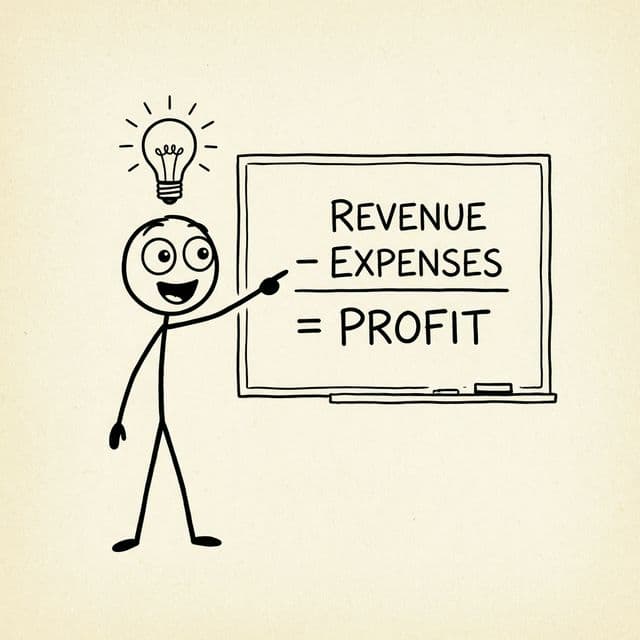
💡 The lightbulb moment
Imagine you're an investor. Two founders walk into your office.
If you just looked at net profit, you'd think Jake is doing slightly better ($15K vs $10K). But when you look at EBITDA, Sarah's business is generating almost 3x more from core operations.
Her lower net profit is because of the loan interest and machine depreciation — both temporary. Once the loan is paid off, her profits will jump. Jake's business is maxed out.
This is exactly why smart investors always ask: “What's your EBITDA margin?” They're not being fancy. They're just looking past the noise.
Let's step out of Sticky's world for a sec and look at some hypothetical companies to see EBITDA in action.
🍕 QuickBite's EBITDA Journey
Imagine a food delivery startup called QuickBite. For years, everyone said “QuickBite is burning cash, it'll never be profitable.” And by net profit standards, they were right — QuickBite posted losses for years.
But here's what the smart investors were tracking: QuickBite's EBITDA was improving every single quarter. The core food delivery business was actually getting closer to making money.
Eventually, QuickBite turned EBITDA positive. The stock price? It had already rallied by that point because investors who understood EBITDA saw it coming quarters early.
🏢 DeskHub's EBITDA Problem
Now imagine a co-working startup called DeskHub. The opposite story. Massive revenue. Billions in memberships. Rapid expansion across 30+ countries.
But their EBITDA was deeply negative. For every $100 they earned, they were spending $130-140 on operations alone. The core business was bleeding money even before you added interest on their massive debt.
When investors saw this, funding dried up. DeskHub had to close hundreds of locations, lay off thousands, and completely restructure. Revenue looked great. EBITDA told the real story.
☕ Sticky's Cart vs. A VC-Funded Café
Suppose a VC-funded café opens right next to Sticky's cart. Air conditioning, Instagram-worthy interiors, a barista with a man-bun, and oat milk.
Their revenue? $10,000/day. Crushing Sticky. But their rent is $3,000/day. Staff: $2,000. Premium ingredients: $2,400. Marketing: $1,000. Their EBITDA? $1,600/day. EBITDA margin: 16%.
Sticky's EBITDA? $235/day. EBITDA margin: 39%.
Sticky is running a way healthier business. And that, my friends, is why EBITDA matters more than big revenue numbers.
Sticky's low-key profitable empire 💰
Now, I'd be doing you dirty if I didn't tell you the other side. EBITDA isn't perfect. Warren Buffett himself called it “misleading” in some contexts. Here's why:
So let's go back to Sticky. After learning all this (and watching 47 episodes of investor pitch shows), Sticky does the math properly.
Now when Max walks up again with his MBA attitude, Sticky looks him dead in the eye and says:
— Sticky, Founder & CEO, Sticky's Coffee Cart
Max's jaw drops. The other customers start clapping. A TV producer in line starts recording.
Okay maybe that last part didn't happen. But you get the point. 😄
EBITDA isn't just a fancy word MBA grads throw around to sound smart. It's genuinely one of the most useful metrics to understand any business — from a coffee cart to a tech unicorn.
Next time you hear an investor ask “What's your EBITDA?” — you'll know exactly what they're really asking: “Does this business actually make money from what it does, or is it all smoke and mirrors?”
And if someone asks you at a party — just tell them the story of Sticky and his coffee cart. Trust me, it works better than any textbook definition.